Vanda merrillii
Ames & Quisumb. 1932
Section Deltoglossa
Version française complète ci-dessous.
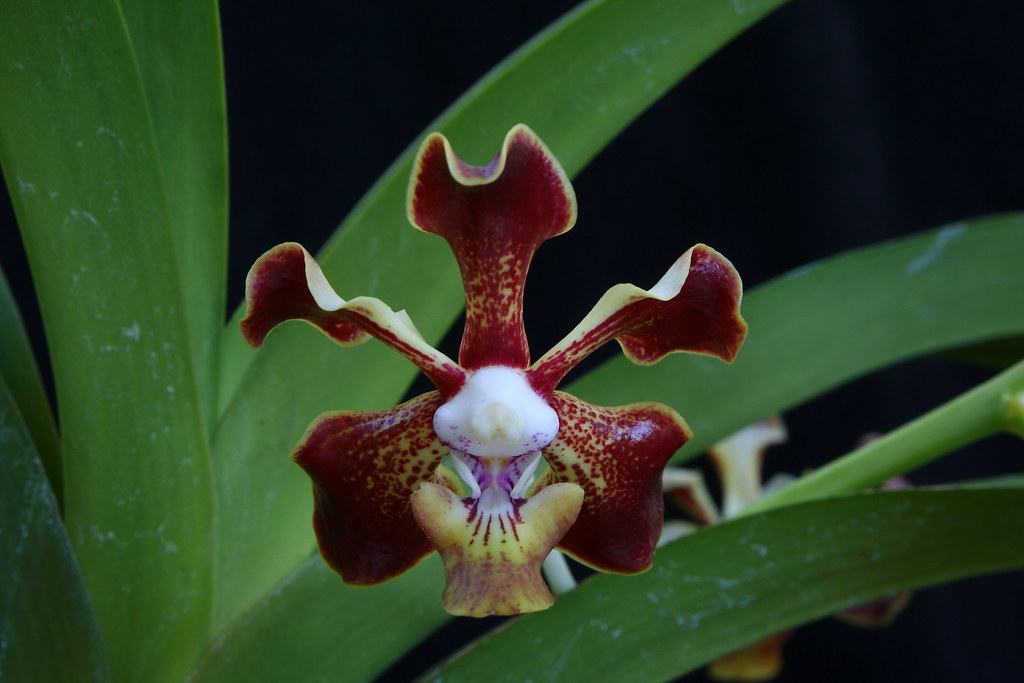
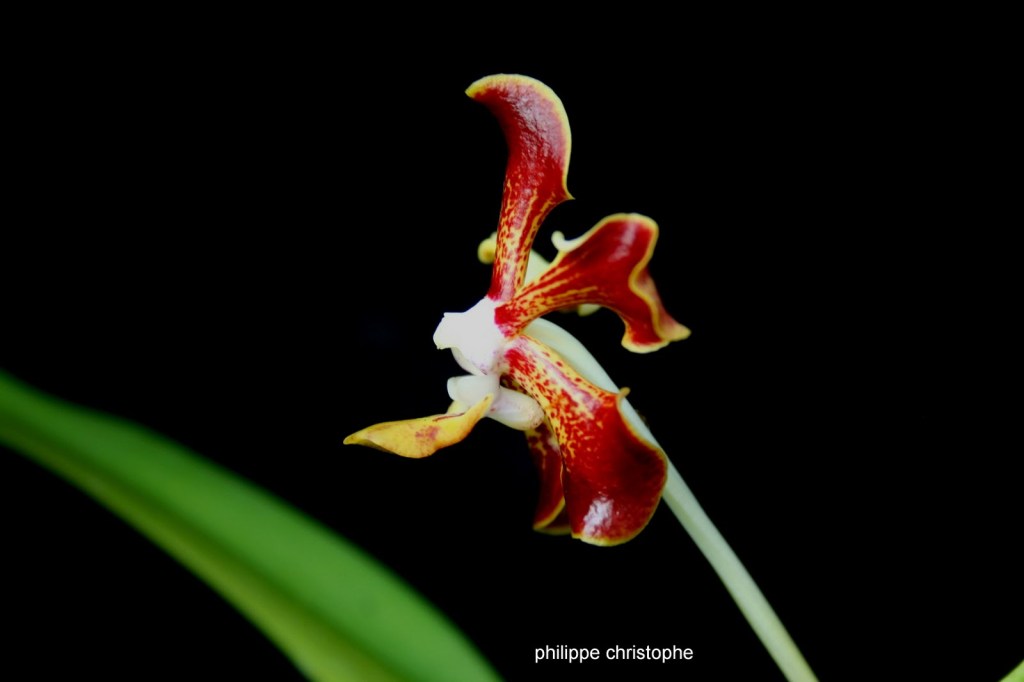
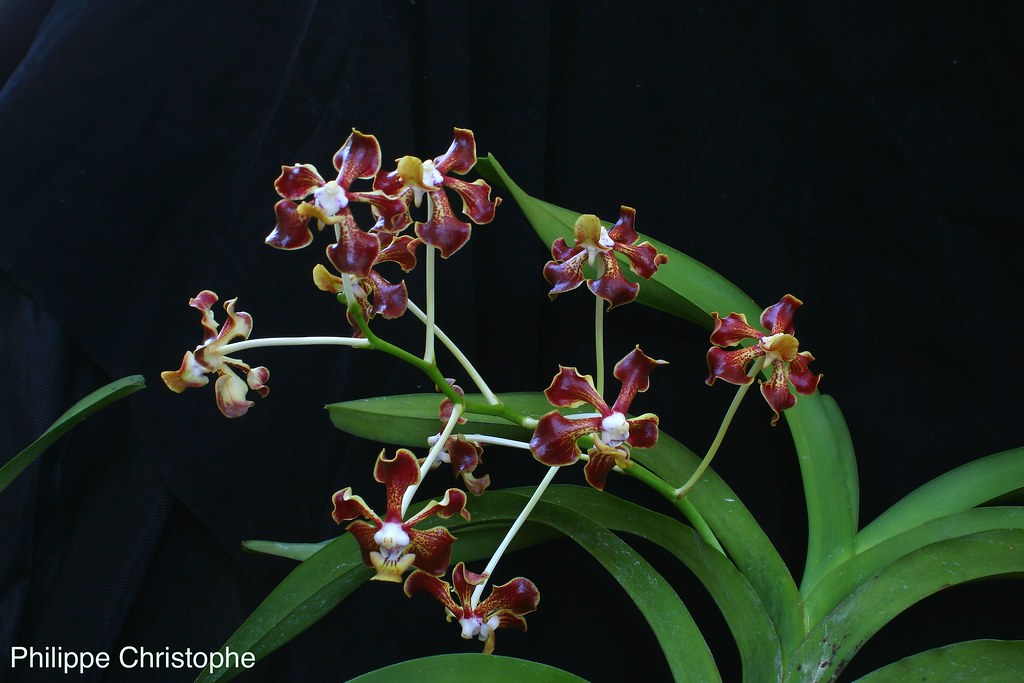
Bright colours, frequent flowering, and a distinctive fragrance make Vanda merrillii one of the most attractive species in the genus. The intense red colour of its flowers is particularly striking and remains highly distinctive among Vanda, while their glossy texture further enhances their ornamental appeal.
The species was named in honour of Elmer Drew Merrill (1876–1956), the American botanist renowned for his major contributions to the study of Philippine flora.
It is a typical member of section Deltoglossa : a large and robust plant with strap-shaped leaves, a delta-shaped lip, a short thick trilobed column, and small rectangular lateral lobes.
Varieties
Two notable varieties have been described:
• Vanda merrillii var. immaculata, originating from Aurora, Nueva Ecija and Quezon provinces in Luzon, and also reported from Cotabato in Mindanao, is extremely rare. Its flowers are pale cream yellow.
• Vanda merrillii var. rotorii, also originating from Aurora and Nueva Ecija in Luzon, bears uniform dark red flowers. Its fragrance is noticeably different from that of the typical species.
Possible confusion with hybrids
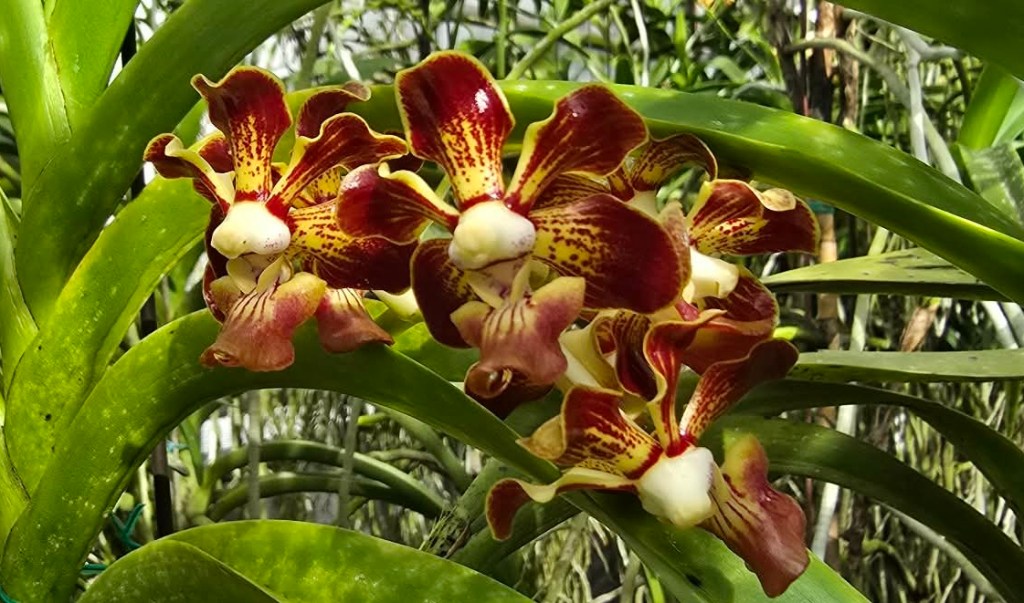
Many plants labelled Vanda merrillii, including some awarded by the American Orchid Society, are in fact Vanda Trimerrill (tricolor × merrillii).
These hybrids generally produce fewer flowers, but larger ones and with longer duration.
Growers who have experienced true Vanda merrillii in bloom usually remember its very specific fragrance — extremely soft, sweet and clearly different from that of Trimerrill.
Despite its remarkable qualities — deep glossy red colour, frequent flowering throughout the year, and delicate fragrance — the species has not been extensively used in hybridisation. Its flowers show relatively open spacing between sepals and petals, remain small, and have limited longevity.
Although not extensively used in modern hybridisation, Vanda merrillii has transmitted one highly distinctive characteristic to several descendants: the remarkable glossy texture of its flowers. This lacquered surface, particularly striking under natural light, remains visible in certain second- and third-generation hybrids and contributes a depth of colour rarely matched in other breeding lines.
In cultivation
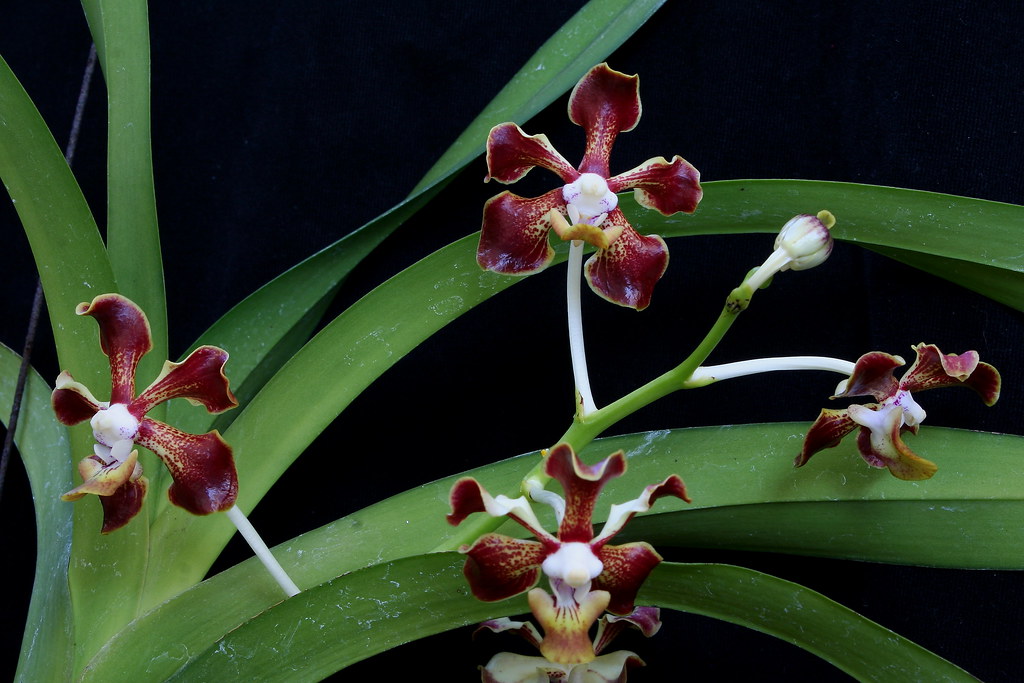
The species has long attracted specialist growers because of its unusual colour, fragrance and floriferous habit. True plants, however, remain uncommon in cultivation, and confusion with hybrids has often obscured its identity in collections.
Distribution
Endemic to the Philippines, around 500 m altitude: Luzon (Aurora, Nueva Ecija and Quezon), Negros (Oriental and Occidental), and Mindanao.
Flowers
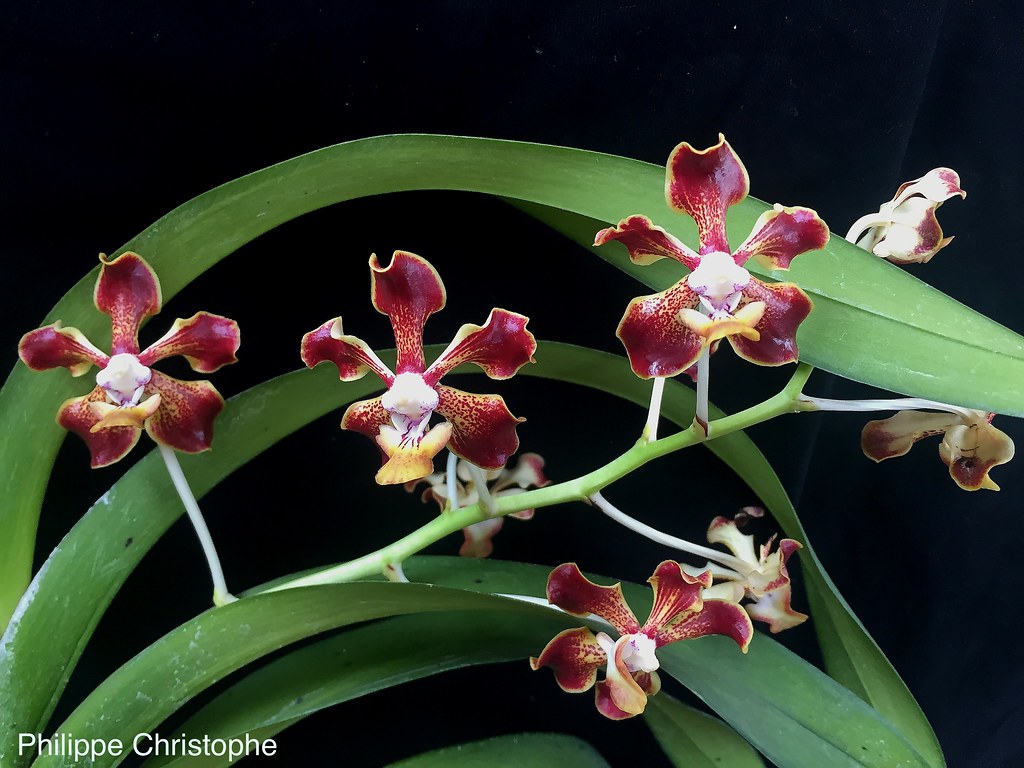
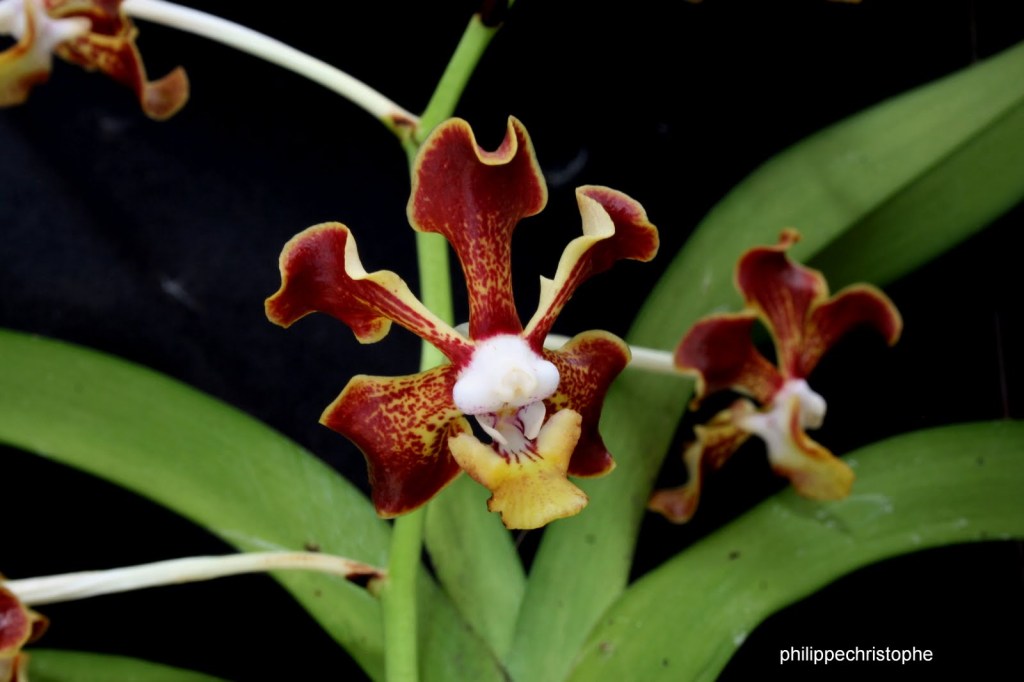
• Size: 3.5–4 cm, strongly fragrant during daytime.
• Shape: sepals and petals spatulate, glossy, with a yellow background overlaid with blood red, intensifying toward the extremities.
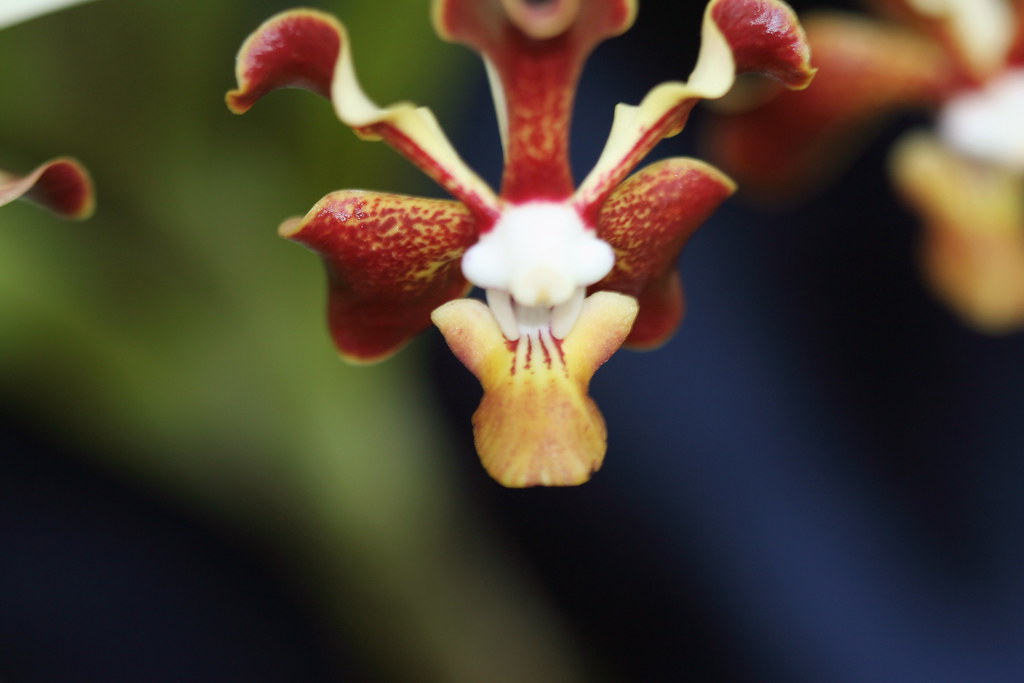
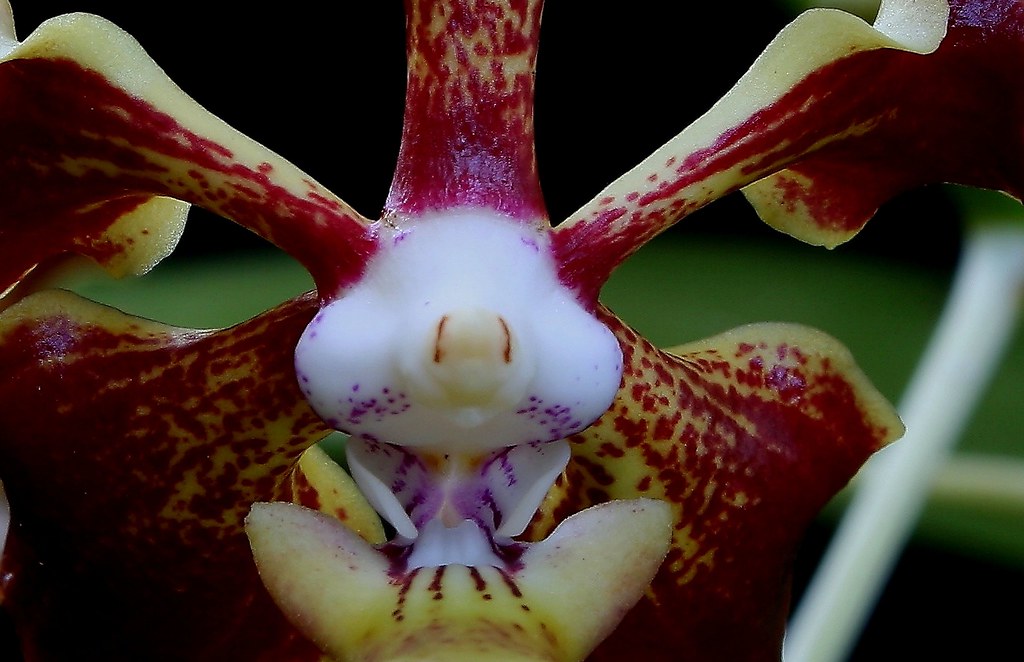
• Lip: yellow, delta-shaped, marked at the base with red ridges, more or less reniform; mid-lobe suffused with red, sometimes more extensively coloured; margins occasionally bent downward.
• Spur: short and rounded.
• Lateral lobes: small, rectangular, almost square.
Inflorescence
9 to 16 flowers, up to 25 cm long, delicately arching and approximately equal to the leaves in length. Long pedicels.
Plant
Large-growing species, reaching up to 1.5 m.
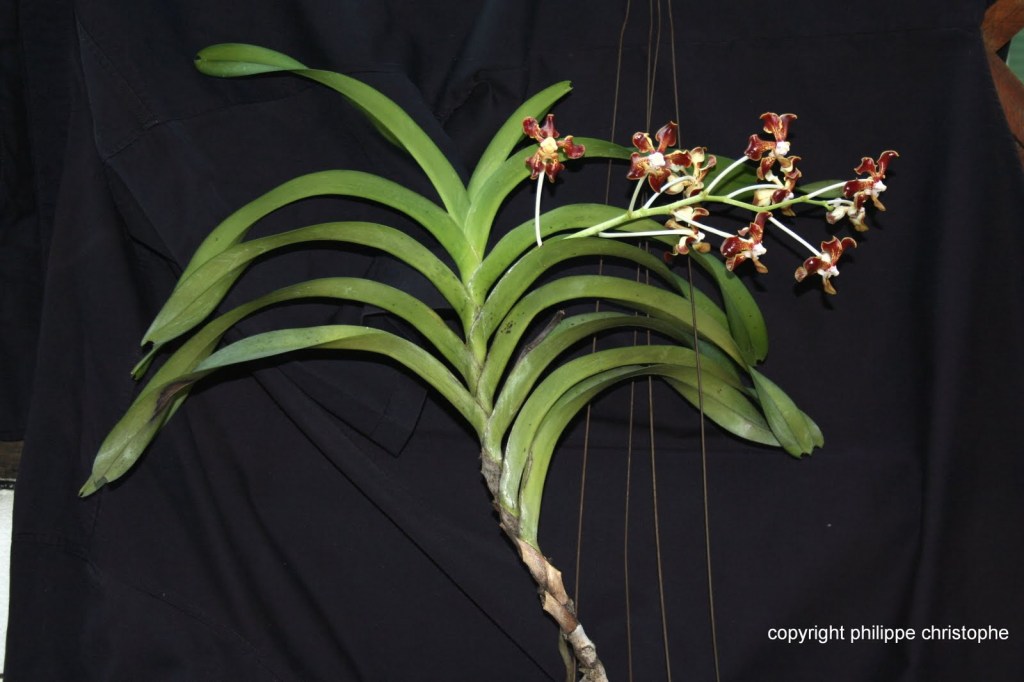
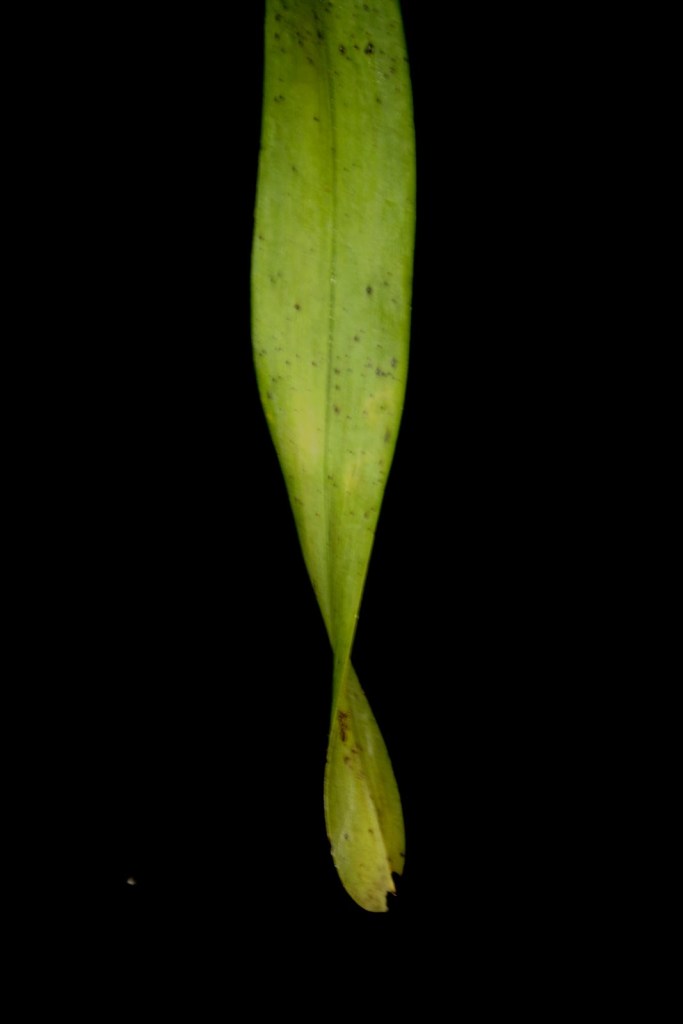
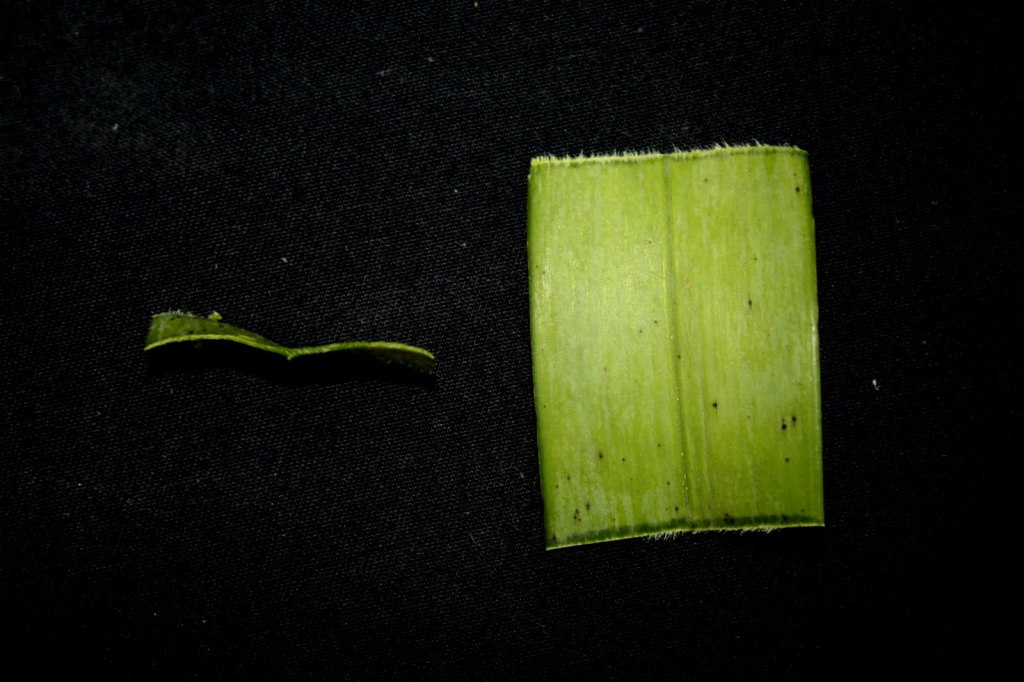
Leaves ligulate, recurved, and robust.
Version française
Vanda merrillii
Ames & Quisumb. 1932
Section Deltoglossa
Les couleurs vives, les floraisons fréquentes et un parfum très particulier font de Vanda merrillii l’une des espèces les plus attractives du genre. La couleur rouge intense de ses fleurs est particulièrement remarquable et demeure très distinctive parmi les Vanda, tandis que leur texture brillante renforce encore leur valeur ornementale.
L’espèce a été nommée en l’honneur d’Elmer Drew Merrill (1876–1956), botaniste américain célèbre pour ses contributions majeures à l’étude de la flore philippine.
Il s’agit d’un représentant typique de la section Deltoglossa : plante grande et robuste, à feuilles rubanées, avec un labelle en forme de delta, une colonne courte, épaisse, trilobée, et de petits lobes latéraux rectangulaires.
Variétés
Deux variétés notables ont été décrites :
• Vanda merrillii var. immaculata, originaire des provinces d’Aurora, Nueva Ecija et Quezon à Luçon, également signalée à Cotabato à Mindanao, est extrêmement rare. Ses fleurs sont jaune crème pâle.
• Vanda merrillii var. rotorii, également originaire d’Aurora et de Nueva Ecija à Luçon, porte des fleurs uniformément rouge foncé. Son parfum diffère nettement de celui de l’espèce type.
Confusion possible avec des hybrides
De nombreuses plantes étiquetées Vanda merrillii, y compris certaines récompensées par l’American Orchid Society, sont en réalité Vanda Trimerrill (tricolor × merrillii).
Ces hybrides produisent généralement moins de fleurs, mais de plus grande taille et de durée supérieure.
Les cultivateurs ayant observé la véritable espèce en floraison retiennent souvent son parfum très particulier : extrêmement doux, sucré, et nettement différent de celui de Trimerrill.
Malgré ses qualités remarquables — rouge profond brillant, floraisons répétées au cours de l’année et parfum délicat — l’espèce a été peu utilisée en hybridation. Ses fleurs présentent un espacement relativement ouvert entre sépales et pétales, restent de petite taille et leur durée est limitée.
Bien que peu employée dans l’hybridation moderne, Vanda merrillii a transmis à plusieurs descendants une caractéristique très distinctive : la remarquable texture brillante de ses fleurs. Cet aspect laqué, particulièrement frappant sous lumière naturelle, demeure visible chez certains hybrides de deuxième et troisième génération et apporte une profondeur de couleur rarement égalée dans d’autres lignées.
En culture
L’espèce attire depuis longtemps les collectionneurs spécialisés par sa couleur inhabituelle, son parfum et sa floribondité. Les véritables plantes restent cependant peu fréquentes en culture, et la confusion avec des hybrides a souvent brouillé son identité dans les collections.
Distribution
Espèce endémique des Philippines, vers 500 m d’altitude : Luçon (Aurora, Nueva Ecija et Quezon), Negros (Oriental et Occidental), et Mindanao.
Fleurs
• Taille : 3,5 à 4 cm, fortement parfumées durant la journée.
• Forme : sépales et pétales spatulés, brillants, à fond jaune recouvert de rouge sang, plus intense vers les extrémités.
• Labelle : jaune, en forme de delta, marqué à la base de crêtes rouges, plus ou moins réniforme ; lobe médian suffusé de rouge, parfois plus largement coloré ; marges parfois infléchies vers le bas.
• Éperon : court et arrondi.
• Lobes latéraux : petits, rectangulaires, presque carrés.
Inflorescence
9 à 16 fleurs, jusqu’à 25 cm de longueur, délicatement arquée et d’une longueur approximativement égale à celle des feuilles. Pédicelles longs.
Plante
Espèce de grande taille pouvant atteindre 1,5 m.
Feuilles ligulées, recourbées et robustes.
 Vandaspecies