Vanda denisoniana
Bens. & Rchb.f. 1869
Section Obtusiloba
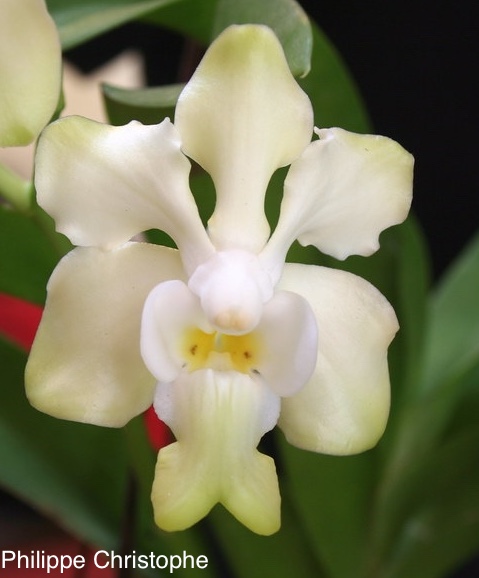
Vanda denisoniana is a highly attractive species and widely represented in cultivation. Unlike most species in the genus, which are fragrant during the day, Vanda denisoniana is fragrant in the evening and morning.
It is a typical member of section Obtusiloba, characterized by broad, rounded lateral lobes. These mid- to montane species share a continuous distribution from Myanmar to Vietnam, through Thailand, Laos, and Yunnan. They are closely related and frequently confused, which has long led to identification errors.
The entire complex of taxa, including forms with spots or tessellations, has long been poorly defined and a source of confusion. Subsequently, several taxa were described, including the varieties punctata, hebraica, and tessellata.
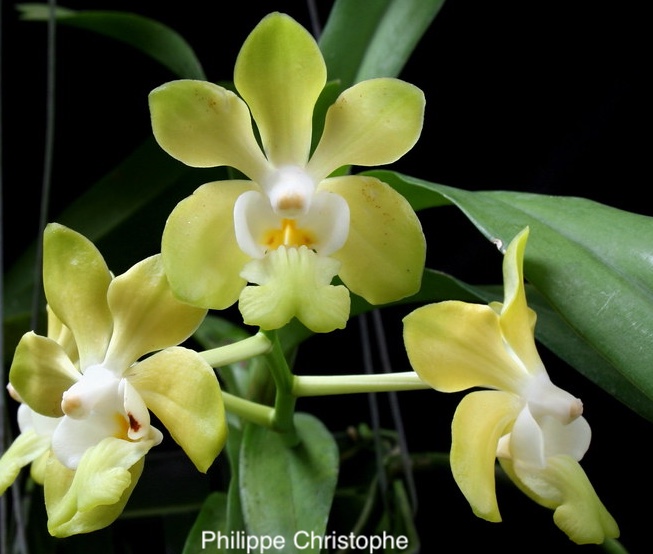
Vanda brunnea was described in 1868 by Heinrich Reichenbach based on plants collected in Myanmar by Charles Parish, characterized as brown and tessellated but also other forms that were lighter yellow and marked.
In 1869, Reichenbach described Vanda denisoniana from plants collected in Myanmar by Colonel Robson Benson, with white flowers and yellow-green tones at the apex of sepals, petals, and lip.
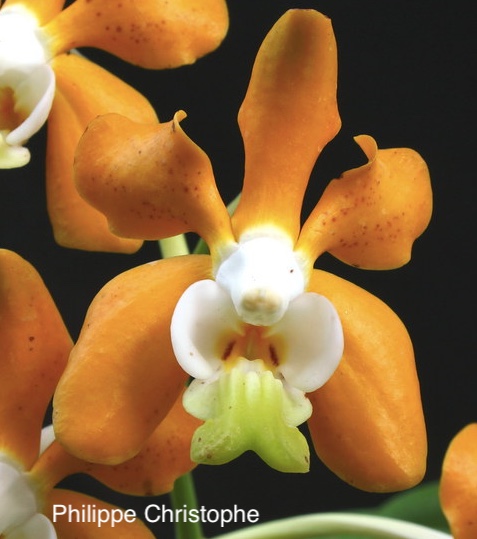
This complex taxonomic situation remained unresolved for a long time. Gunnar Seidenfaden was among the first to significantly advance its clarification, providing an initial framework for a more rigorous interpretation of the taxa.
Later, the study by Martin Motes, Gardiner & Roberts, The identity of spotted Vanda denisoniana (Orchid Review, 2016), provided a clearer conceptual framework, allowing better separation of Vanda brunnea, Vanda denisoniana, and the intermediate forms that had long been difficult to classify, although not considered fully definitive by the authors.
This study demonstrates that genetic introgression between Vanda brunnea and Vanda denisoniana, in both directions, explains the occurrence of spotted and tessellated flowers. These forms are best interpreted as natural hybrids, referred to as Vanda × hebraica, rather than Vanda denisoniana var. hebraica.
Within this framework, morphological variation in Vanda denisoniana can be better interpreted.
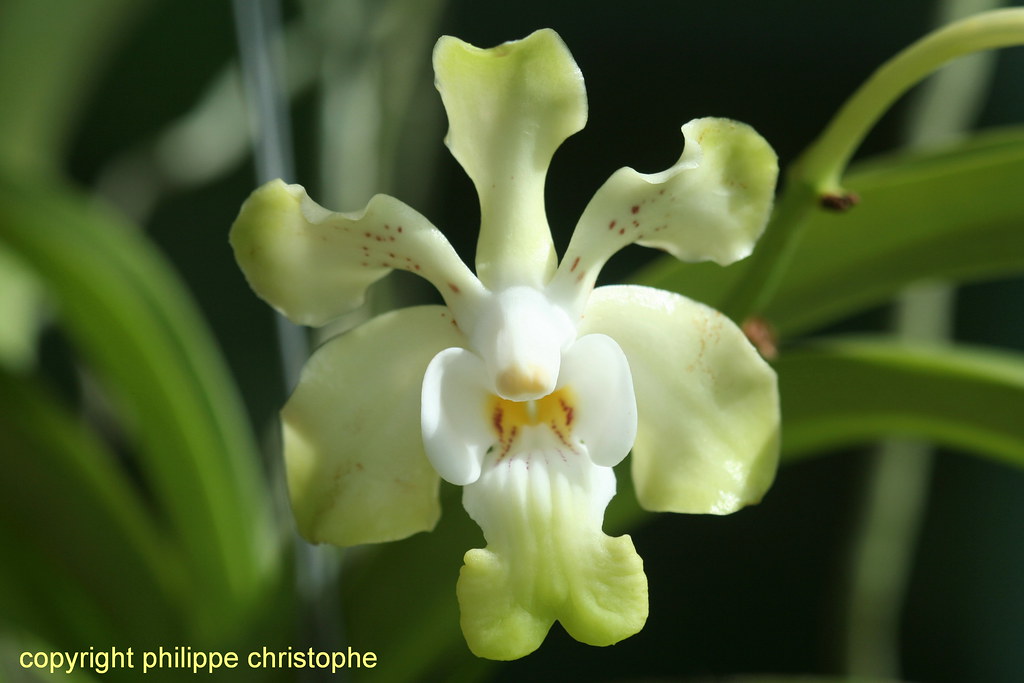
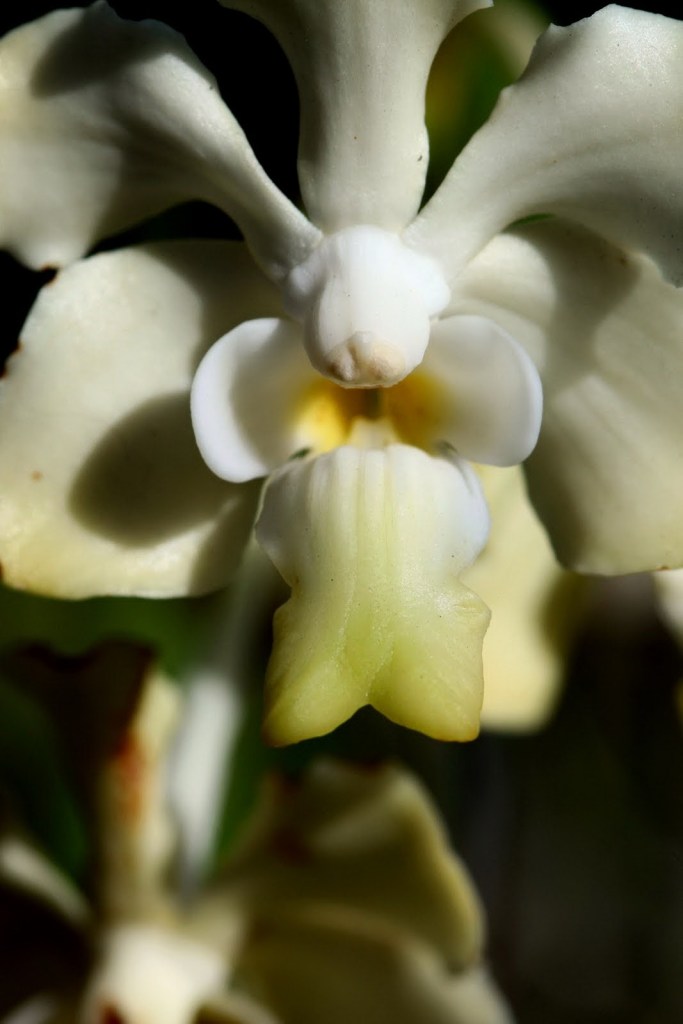
- Pure forms of Vanda denisoniana are white to deep yellow, without spots or markings. The lip is yellow-green, broadly pandurate, with pale yellow lateral lobes at the base.
- Forms with small black dots, very common in nature and cultivation, correspond to natural hybrids between Vanda denisoniana and Vanda brunnea, known as Vanda × hebraica, rather than true infraspecific variants (a dedicated article will follow on this blog).
- Plants with brownish flowers, narrower and slightly twisted tepals, and a lip with a reddish-brown apex correspond to a more recently described species (2021): Vanda gardinerae (article forthcoming).
- Vanda brunnea presents brown, strongly tessellated flowers (a dedicated article will be published soon on this blog).
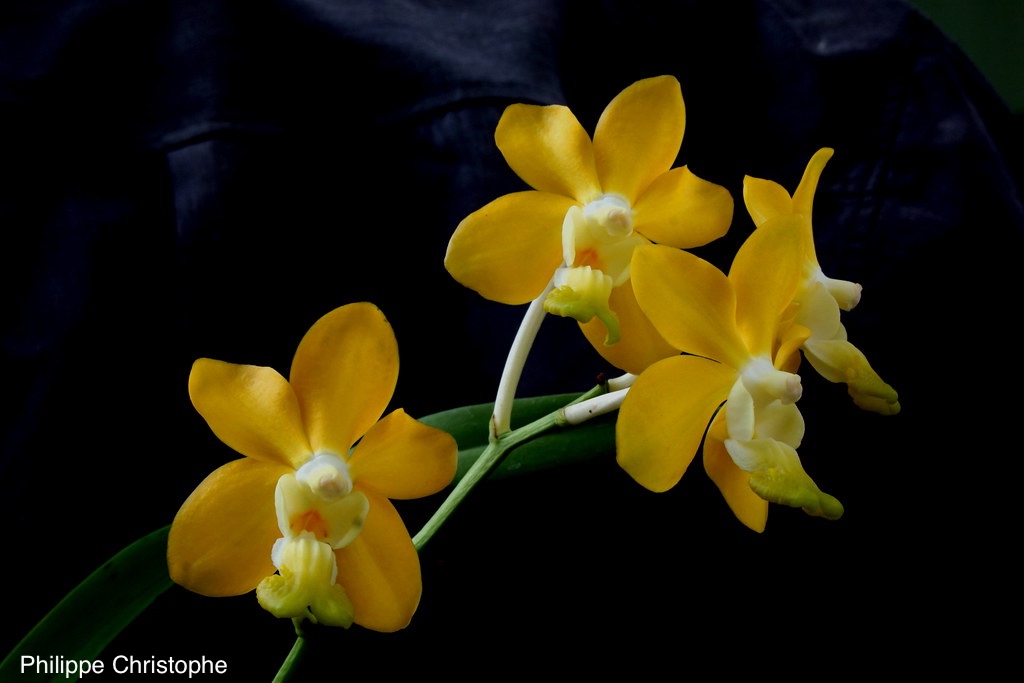
Several photographs illustrating pure Vanda denisoniana and Vanda × hebraica in that study are by the author of this blog and are also reproduced here. The same applies to many images published in The Natural Genus Vanda by Martin Motes.
The species was dedicated to Lady Denison (1809–1841), wife of Lord Albert Denison, an orchid enthusiast.
Synonyms
Vanda henryi, Vanda micholitzii
Distribution
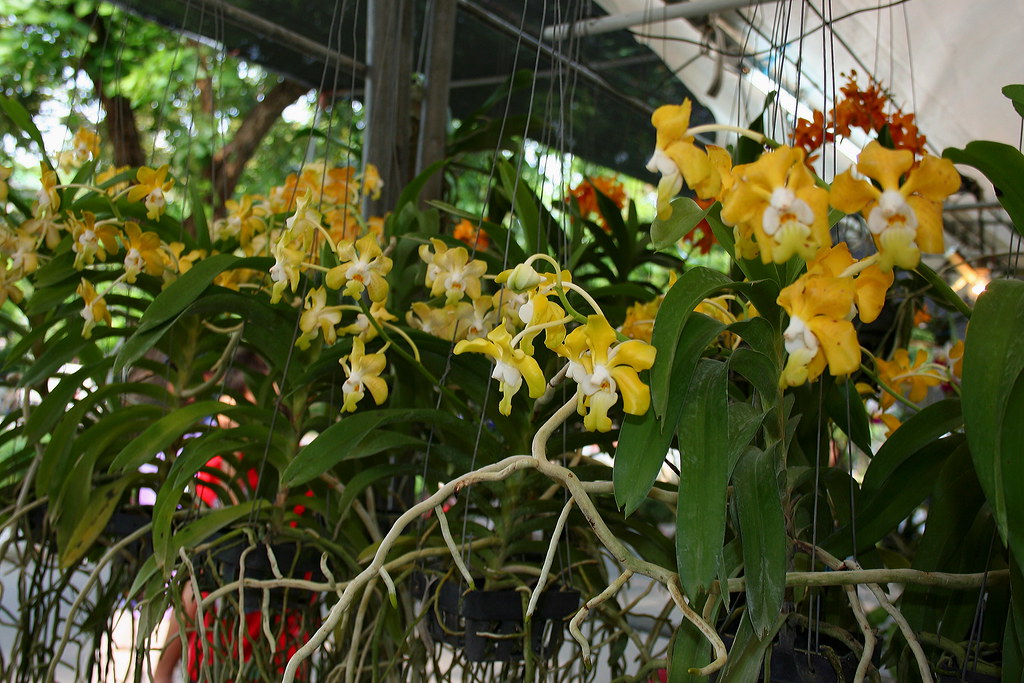
Mountain to mid-mountain species occurring between 450 and 1200 m elevation, found in northeastern Myanmar, Yunnan (China), Laos, northern and northeastern Thailand, and northern Vietnam.
Vernacular names
Myanmar: Thayet Htaew
Laos: Euang Nang Nouane
Thailand: Sam Poi Khun Tan
Vietnam: Lan thanh nga, Mỹ dung dạ hương
Flowers
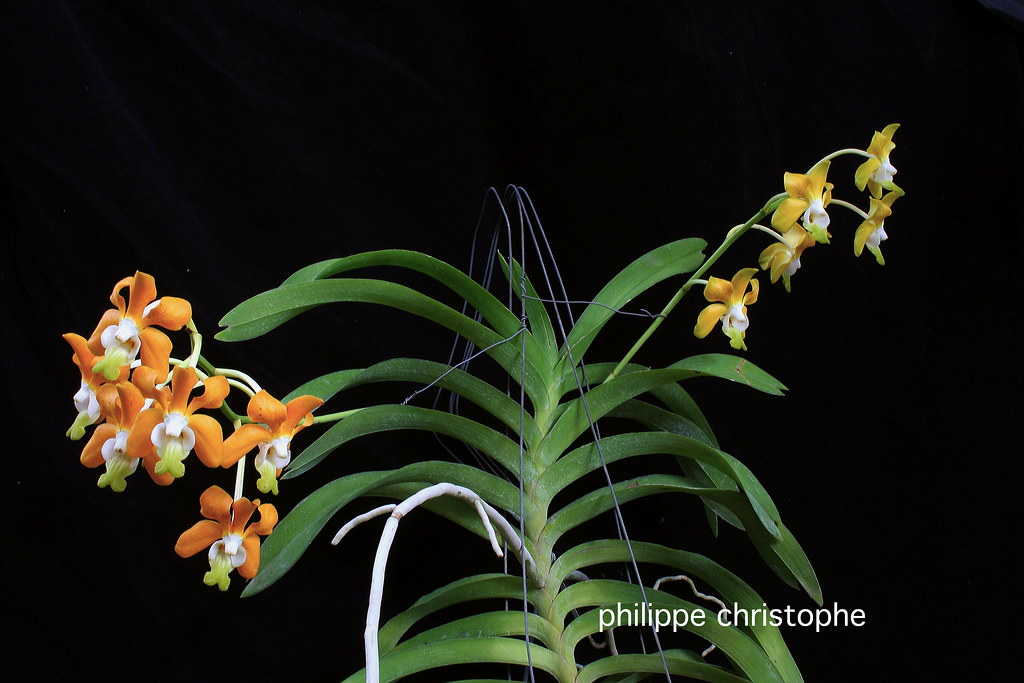
Flowers 5–6 cm, waxy, long-lasting, pleasantly fragrant in the morning and evening. Color variation includes ivory white, golden yellow, lemon yellow, greenish, and orange tones.
Tepals are generally rounded to sub-orbicular, sometimes more expanded or almost rectangular depending on forms.
The lip is broad, with five ridges, orange-marked at the base, and strongly bilobed at the apex. The mid-lobe is yellow-green, lateral lobes large and rounded, pale yellow at the base. Spur short and conical.
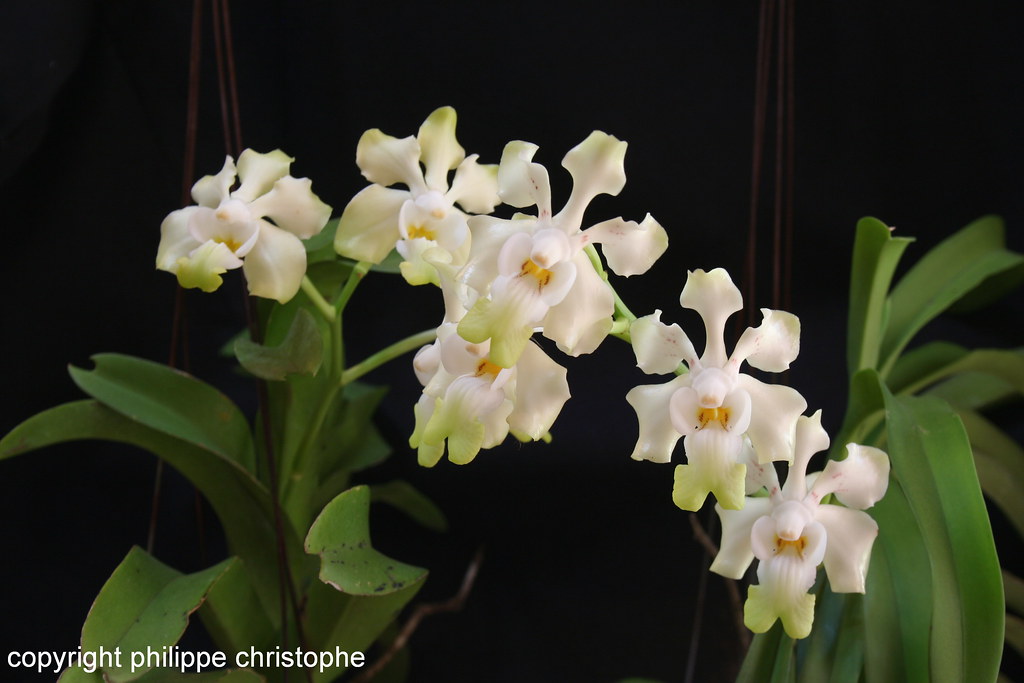
White-flowered forms, often referred to as “alba” in cultivation, are not taxonomically recognized but remain highly valued horticulturally.
Inflorescence
4–8 flowers, erect to sub-erect, 15–18 cm long.
Plant
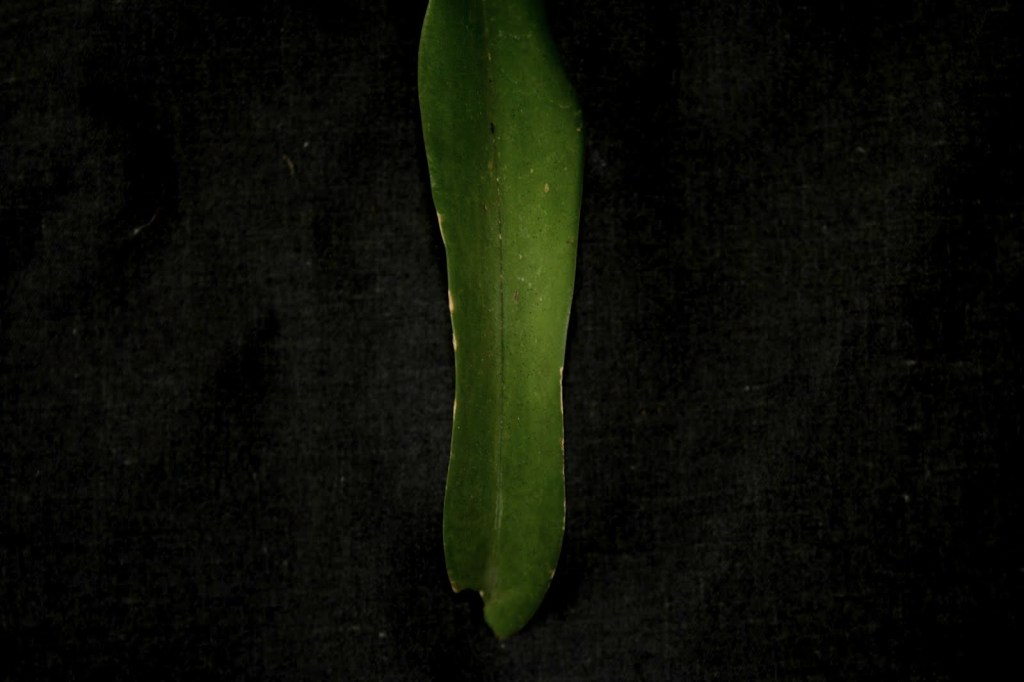
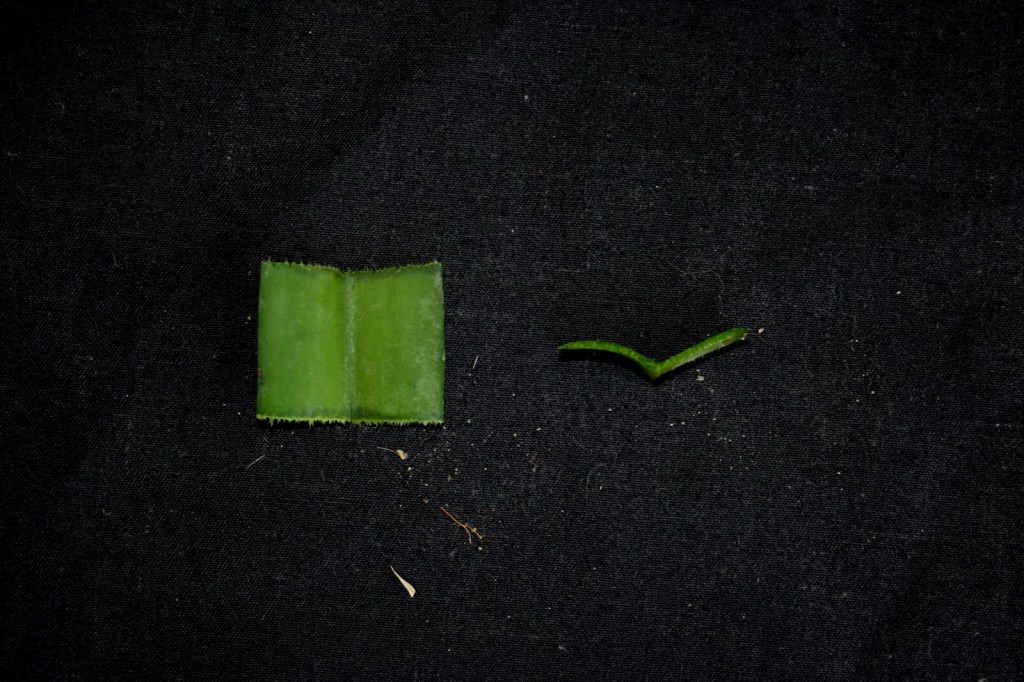
Medium-sized in cultivation, sometimes reaching up to one meter. Leaves ligulate, recurved, and bilobed at the apex.
A relatively easy species in cultivation, mainly due to its montane origin and moderate size.
It is also used in hybridization, particularly for its characteristic fragrance and its yellow, orange, or white color forms.
 Vandaspecies