Vanda roeblingiana
Rolfe (1894)
Section Roeblingiana
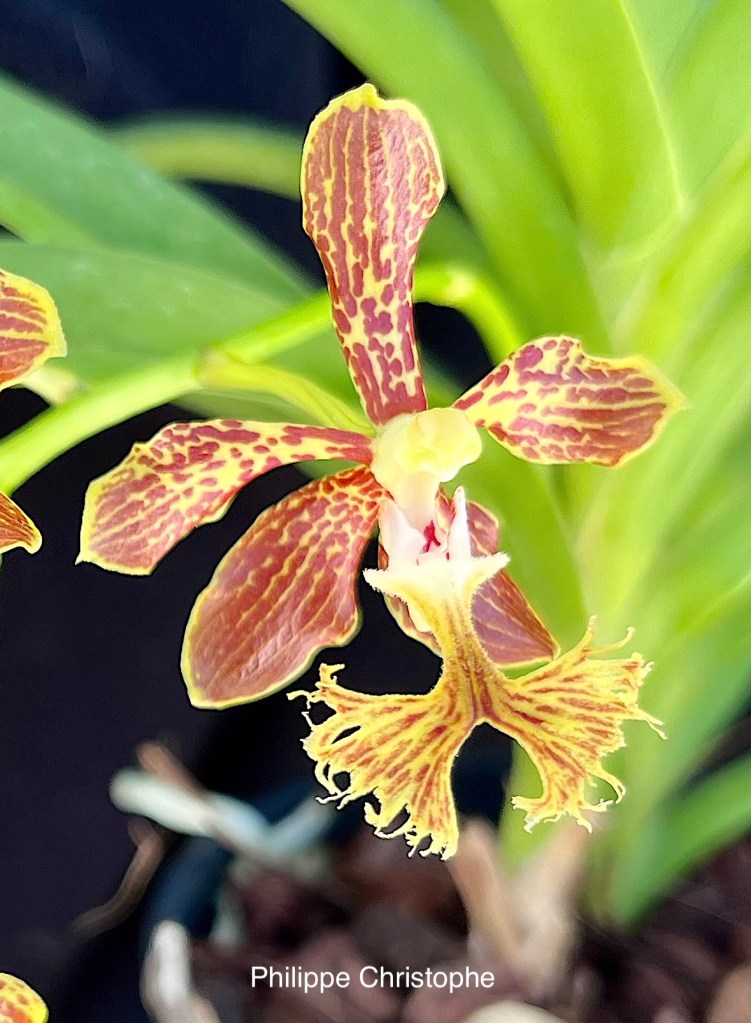
Vanda roeblingiana is a little jewel of the genus Vanda. The flowers, with their yellow background beautifully marked with brick red, possess what is arguably one of the most attractive lips in the genus. In addition, the plants are compact and easy to grow. In short, from experienced orchid enthusiasts to beginner growers, all signs are positive for taking an interest in and cultivating Vanda roeblingiana.
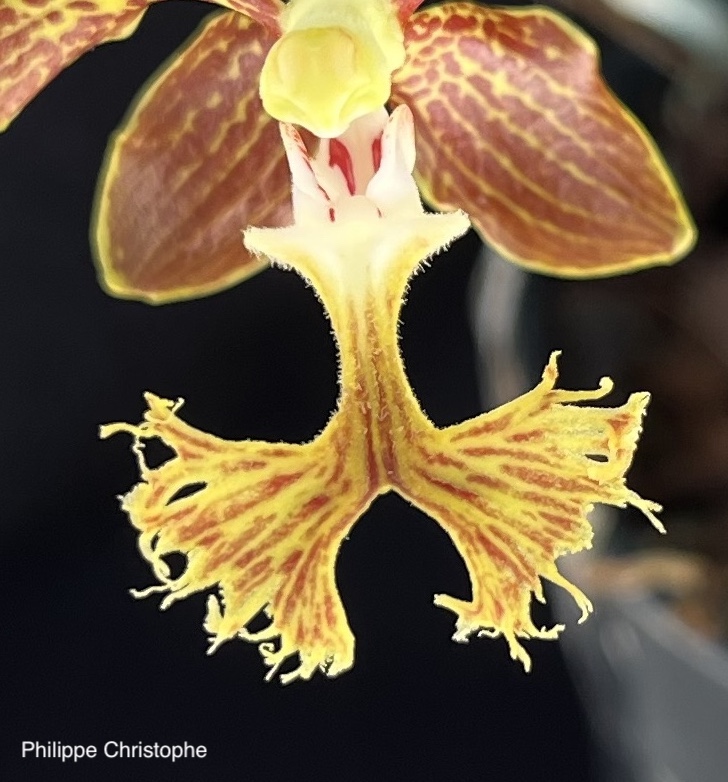
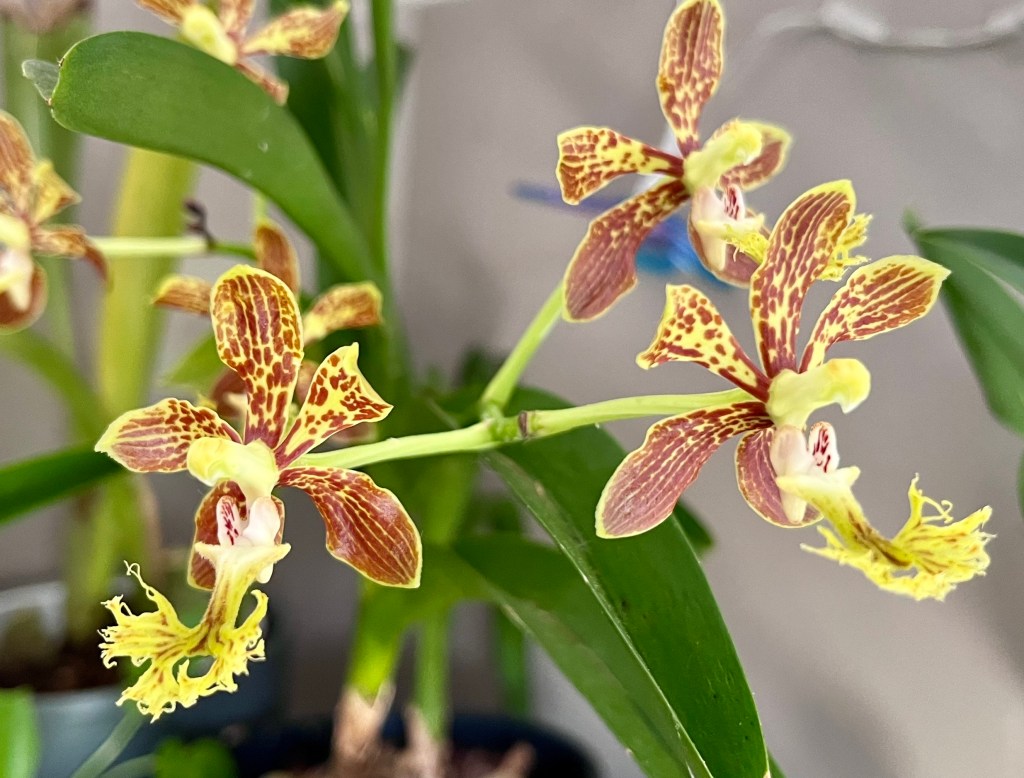
Beyond its desirable colours, one cannot help but admire the shape and refinement of the lip, which is both unique and remarkable. Like the petals and sepals, it is yellow and red and is formed by two delicately fringed lobes. Unfortunately, the unique characteristics of the lip have not been successfully transferred into the hybrids created to date.
Endemic to the Philippines, Vanda roeblingiana is found only in the mountains of northern Luzon. Growing mainly on oak trees at elevations between 1,200 and 2,000 metres, it is one of the few Vanda species that requires a cool period in order to flower and is unlikely to thrive in tropical or equatorial lowland conditions.
Introduced into England in 1893 by the famous plant collector Hugh Low, the species was described one year later by the English botanist Rolfe (1894). It is one of the few Vanda species described from plants already in cultivation in Europe, and this had an interesting consequence: Rolfe, unaware of its true origin, believed it came from Singapore and the surrounding Malay Peninsula. For this reason, Vanda roeblingiana is still occasionally cited as occurring in Malaysia. This is entirely incorrect. Today, the species is known to be endemic to the mountains of Luzon in the Philippines.
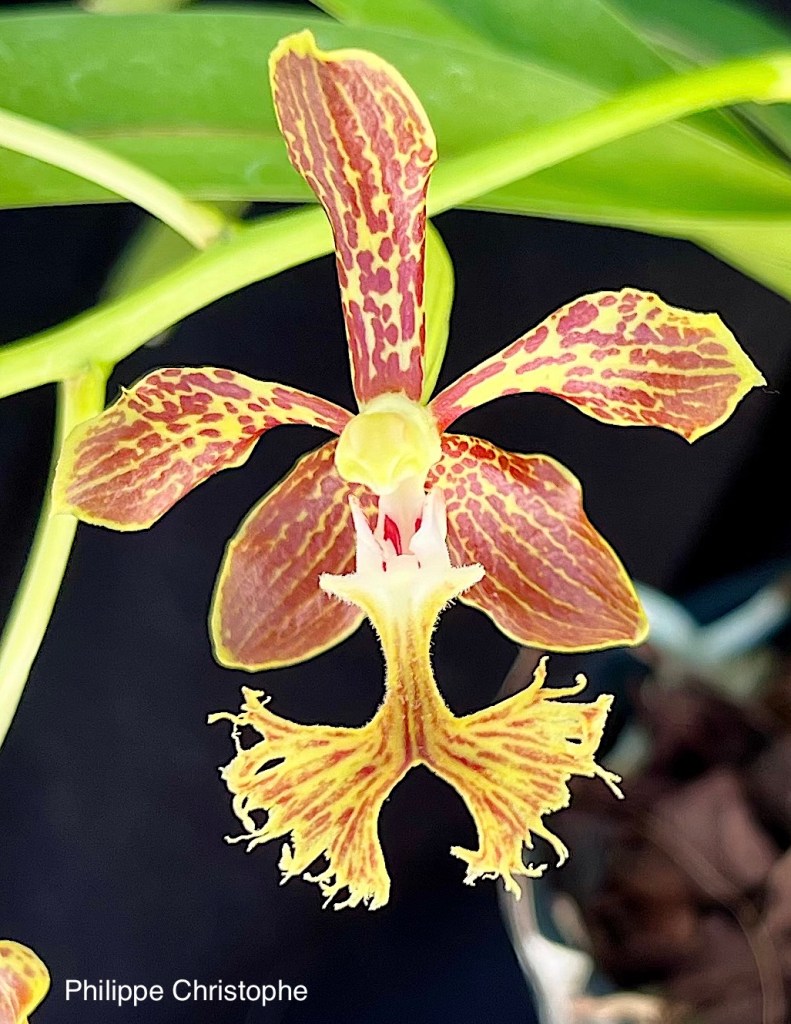
Vanda roeblingiana flower (front view) – showing full symmetry and brick-red markings
The species was named in honour of the American industrialist Roebling of New Jersey, one of the orchid patrons of the era who helped finance botanical expeditions.
In 1994, the taxonomist Eric Christenson placed Vanda roeblingiana in section Roeblingiana because of what he interpreted as two lobules at the base of the lip, a characteristic of that section. However, in 2007, W. Suarez and J. Cootes established section Roeblingiana, to which the species is now assigned.
Distribution
This species is found exclusively in the mountains of Luzon Island, Philippines.
Flowers
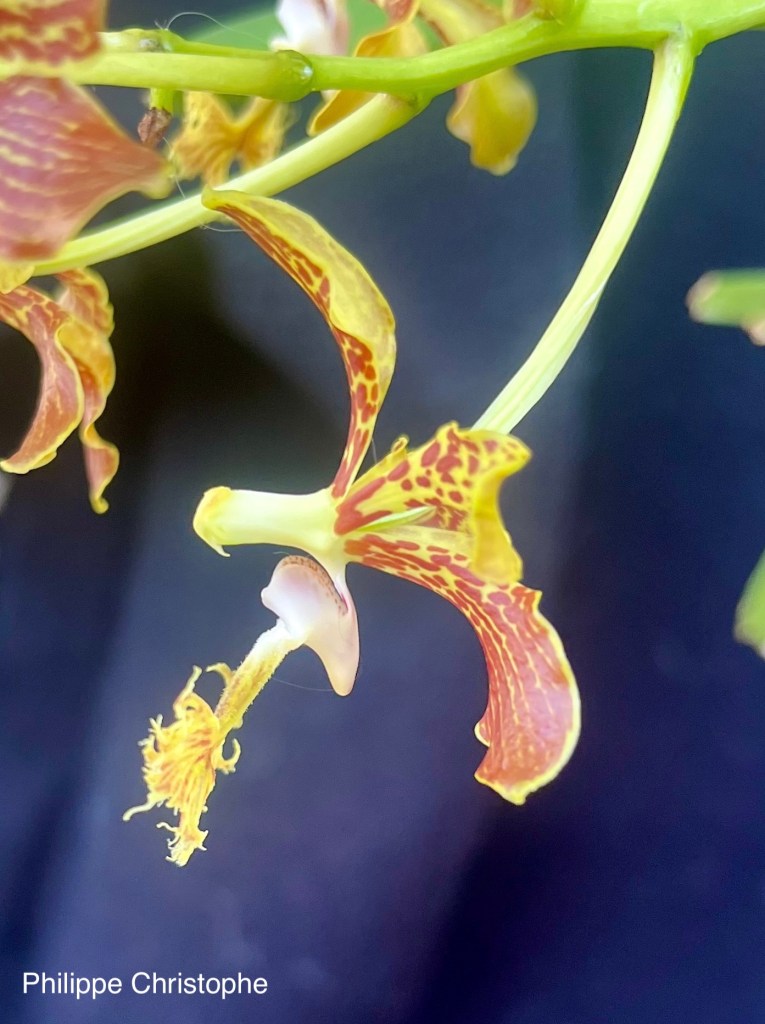
Up to 5 cm in diameter and more or less fragrant. Sepals and petals yellow, heavily overlaid with brick-red markings, sometimes tinged with brown. Lip large in proportion to the tepals. Lip very narrow at the base, extending into two rounded lobules, fringed and covered with fine hairs. Lateral lobes small, rectangular and covered with reddish spots.
Inflorescence
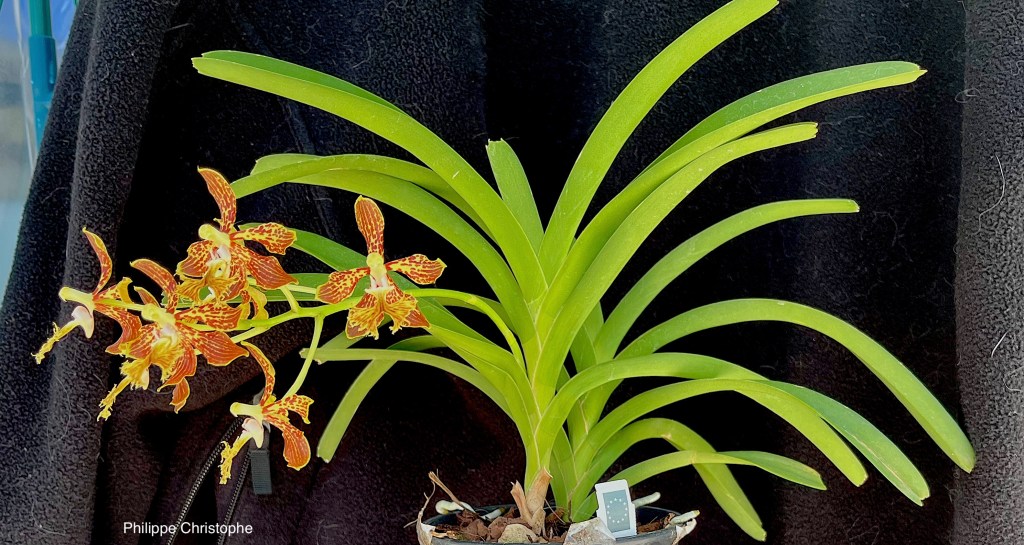
8 to 16 flowers densely clustered along a sub-erect inflorescence up to 30 cm long and usually slightly shorter or slightly longer than the leaves.
Plant
Although plants may flower at only 15 cm in height and some older specimens can reach one meter, they average around 30 cm tall. Vanda roeblingiana has a strong tendency to produce numerous offshoots. Leaves strongly folded lengthwise, conduplicated, V-shaped in cross section, arching, and up to 30 cm long and 4 cm wide.
 Vandaspecies