Vanda roeblingiana
Rolfe (1894)
Section Roeblingiana
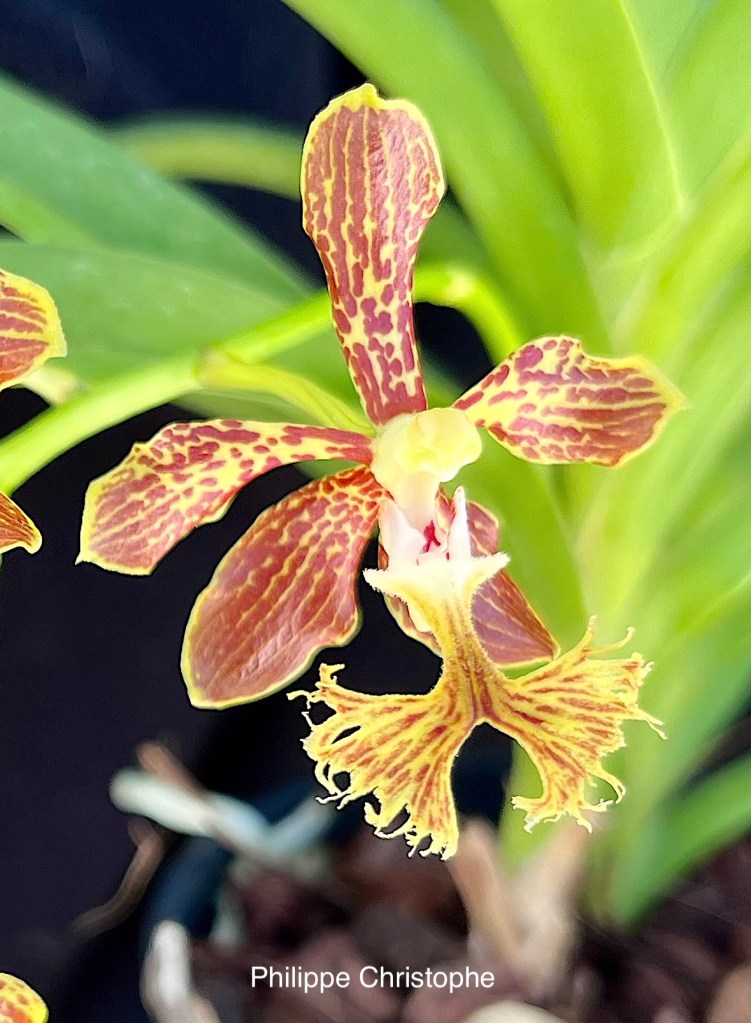
Vanda roeblingiana is a compact orchid species endemic to the mountains of Luzon (Philippines), occurring at cool elevations between 1,200 and 2,000 meters. It is easily recognized by its yellow flowers strongly marked with brick-red and by its distinctive lip morphology. Adaptable and relatively easy to cultivate under suitable conditions, it is considered one of the more accessible Vanda species for growers.
Vanda roeblingiana is a little jewel of the genus Vanda. The flowers, with their yellow background beautifully marked with brick red, possess what is arguably one of the most attractive lips in the genus. In addition, the plants are compact and easy to grow. In short, from experienced orchid enthusiasts to beginner growers, all signs are positive for taking an interest in and cultivating Vanda roeblingiana.
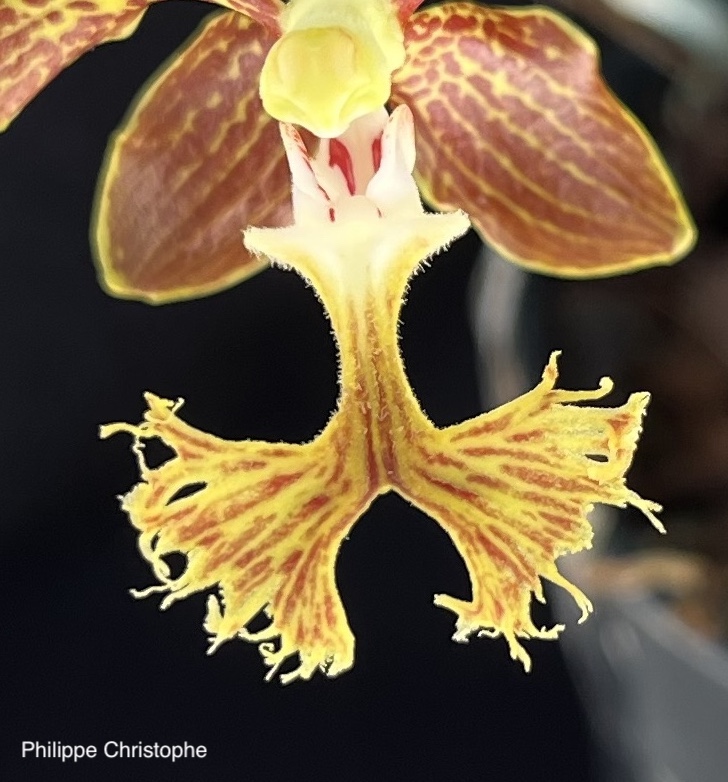
Beyond its desirable colours, one cannot help but admire the shape and refinement of the lip, which is both unique and remarkable. Like the petals and sepals, it is yellow and red and is formed by two delicately fringed lobes. Unfortunately, the unique characteristics of the lip have not been successfully transferred into the hybrids created to date.
Endemic to the Philippines, Vanda roeblingiana is found only in the mountains of northern Luzon. Growing mainly on oak trees at elevations between 1,200 and 2,000 meters, it is one of the Vanda species that requires a cool period in order to flower and is unlikely to thrive in tropical or equatorial lowland conditions.
Introduced into England in 1893 by the famous plant collector Hugh Low, the species was described one year later by the English botanist Rolfe (1894). It is one of the few Vanda species described from plants already in cultivation in Europe, and this had an interesting consequence: Rolfe, unaware of its true origin, believed it came from Singapore and the surrounding Malay Peninsula. For this reason, Vanda roeblingiana is still occasionally cited as occurring in Malaysia. This is entirely incorrect. Today, the species is known to be endemic to the mountains of Luzon in the Philippines.
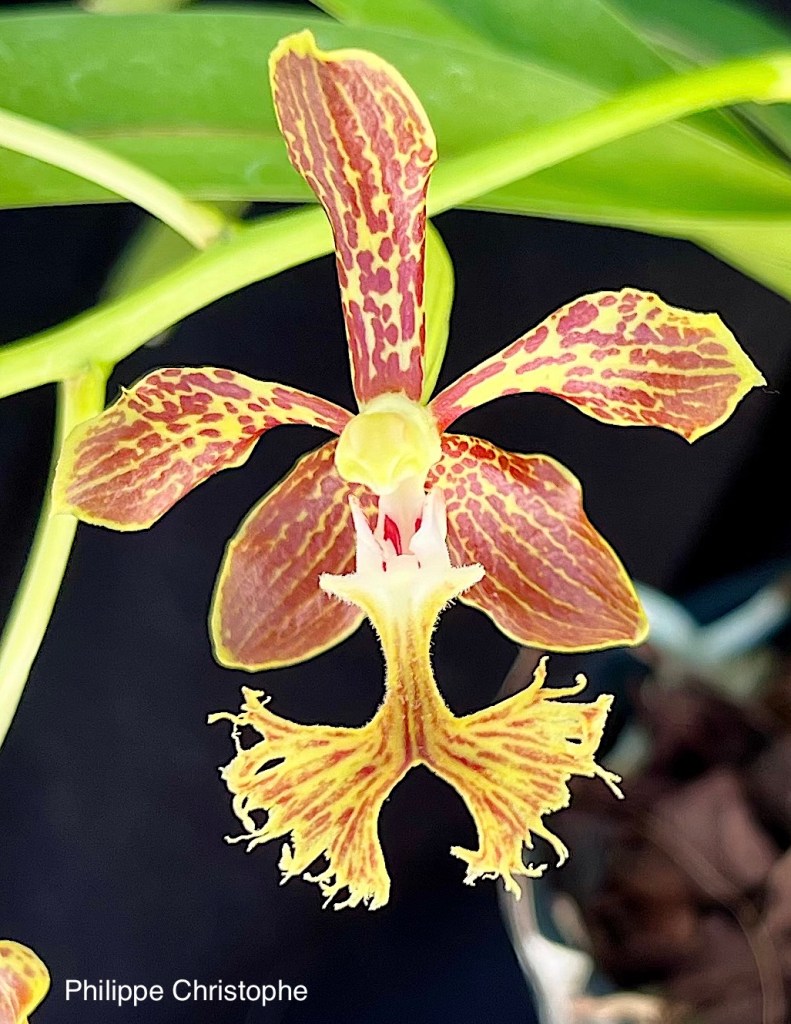
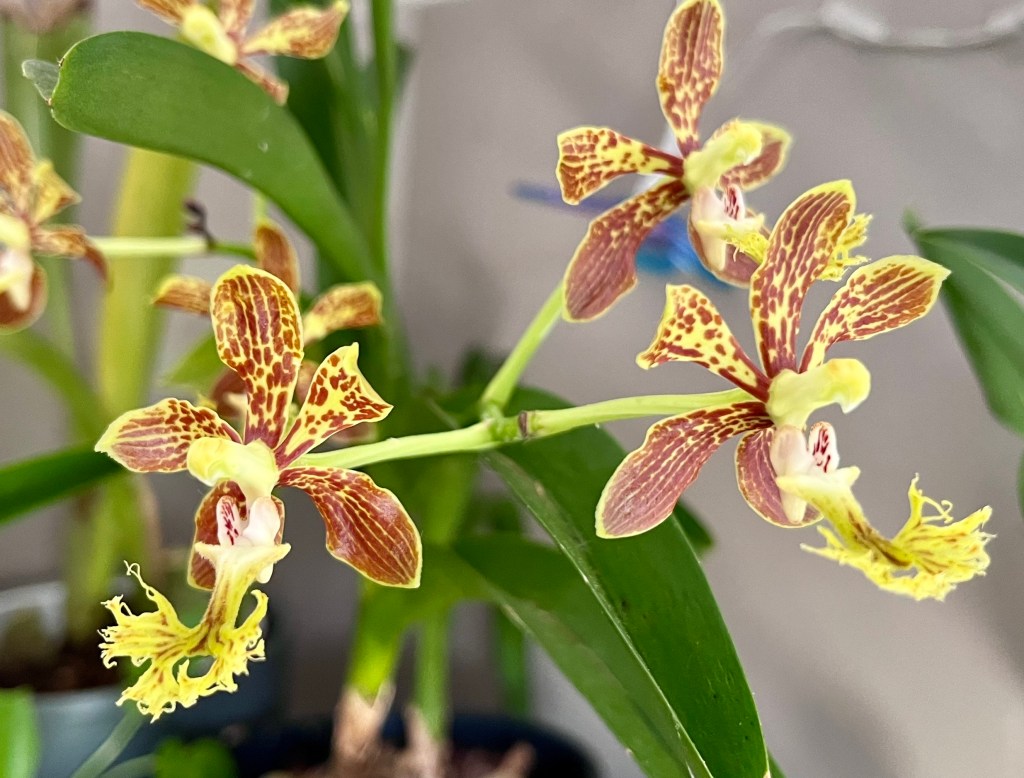
Vanda roeblingiana flower (front view) – showing full symmetry and brick-red markings
The species was named in honour of the American industrialist Roebling of New Jersey, one of the orchid patrons of the era who helped finance botanical expeditions.
In 1994, the taxonomist Eric Christenson placed Vanda roeblingiana in section Hastifera because of what he interpreted as two lobules at the base of the lip, a characteristic of that section. However, in 2007, W. Suarez and J. Cootes established section Roeblingiana, to which the species is now assigned.
Distribution
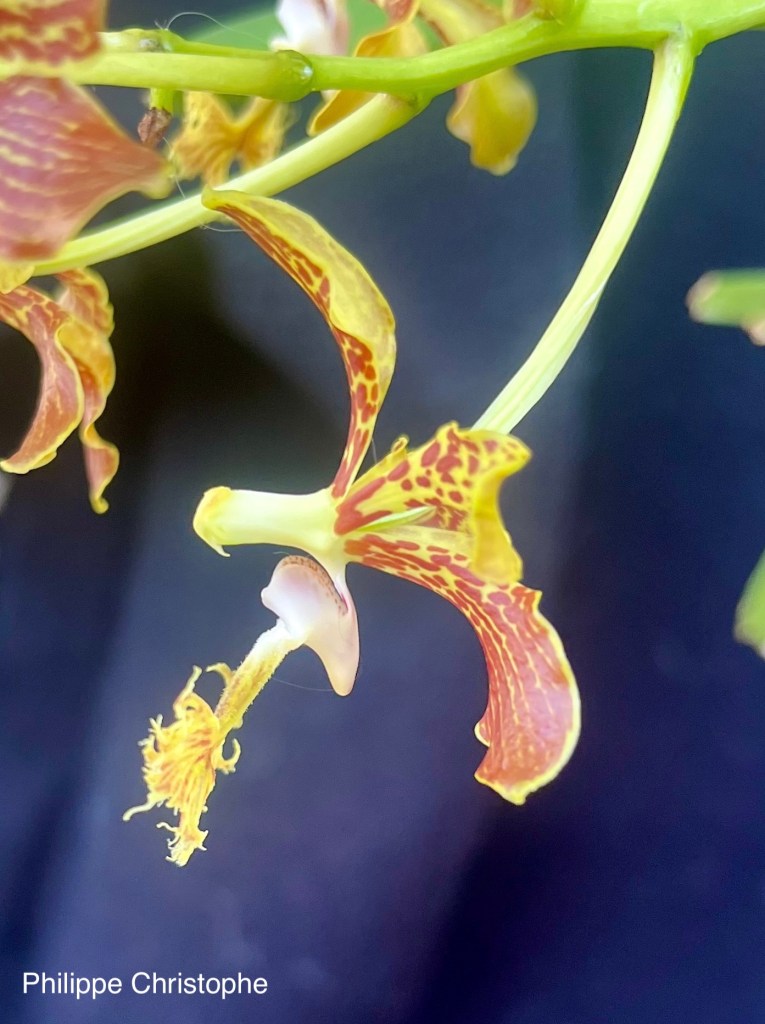
This species is found exclusively in the mountains of Luzon Island, Philippines.
Flowers
Up to 5 cm in diameter and more or less fragrant. Sepals and petals yellow, heavily overlaid with brick-red markings, sometimes tinged with brown. Lip large in proportion to the tepals. Lip very narrow at the base, extending into two rounded lobules, fringed and covered with fine hairs. Lateral lobes small, rectangular and covered with reddish spots.
Inflorescence
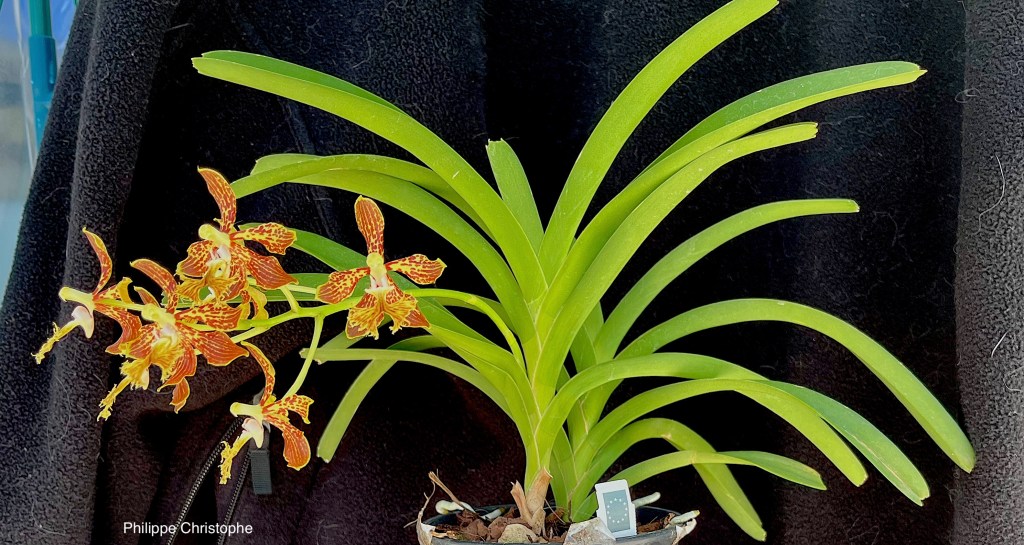
8 to 16 flowers densely clustered along a sub-erect inflorescence up to 30 cm long and usually slightly shorter or slightly longer than the leaves.
Plant
Although plants may flower at only 15 cm in height and some older specimens can reach one meter, they average around 30 cm tall. Vanda roeblingiana has a strong tendency to produce numerous offshoots. Leaves strongly folded lengthwise, conduplicated, V-shaped in cross section, arching, and up to 30 cm long and 4 cm wide.
Related in growth habit and relative ease of cultivation, Vanda roeblingiana can be compared to Vanda lamellata, although the latter typically occurs in warmer lowland habitats.
Version française
Vanda roeblingiana
Rolfe (1894)
Section Roeblingiana
Vanda roeblingiana est une espèce compacte endémique des montagnes de Luçon (Philippines), poussant en altitude fraîche entre 1 200 et 2 000 mètres. Elle se distingue par ses fleurs jaunes fortement marquées de rouge brique et par un labelle caractéristique. Facile à cultiver dans de bonnes conditions, elle figure parmi les Vanda les plus accessibles aux cultivateurs.
Vanda roeblingiana est un petit joyau du genre Vanda. Les fleurs, sur fond jaune joliment marqué de rouge brique, possèdent sans doute l’un des plus attrayants labelle du genre. De plus, les plantes sont compactes et faciles à cultiver. En résumé, de l’orchidophile expérimenté au cultivateur débutant, tous les indicateurs sont favorables pour s’intéresser à la culture de Vanda roeblingiana.
Au-delà de ses couleurs désirables, il est difficile de ne pas admirer la forme et le raffinement du labelle, à la fois unique et remarquable. Comme les pétales et les sépales, il est jaune et rouge et se compose de deux lobes délicatement frangés. Malheureusement, les caractéristiques uniques de ce labelle n’ont pas pu être transmises avec succès dans les hybrides créés à ce jour.
Endémique des Philippines, Vanda roeblingiana ne se rencontre que dans les montagnes du nord de Luçon. Poussant principalement sur des chênes entre 1 200 et 2 000 mètres d’altitude, elle fait partie des espèces de Vanda qui nécessitent une période fraîche pour fleurir et qui ont peu de chances de prospérer dans des conditions tropicales ou équatoriales de basse altitude.
Introduite en Angleterre en 1893 par le célèbre collecteur de plantes Hugh Low, l’espèce fut décrite un an plus tard par le botaniste anglais Rolfe (1894). Elle fait partie des rares espèces de Vanda décrites à partir de plantes déjà cultivées en Europe, ce qui eut une conséquence intéressante : Rolfe, ignorant sa véritable origine, pensait qu’elle provenait de Singapour et de la péninsule Malaise environnante. Pour cette raison, Vanda roeblingiana est encore parfois citée comme présente en Malaisie. Cela est entièrement incorrect. Aujourd’hui, l’espèce est connue comme endémique des montagnes de Luçon, aux Philippines.
L’espèce fut nommée en l’honneur de l’industriel américain Roebling, originaire du New Jersey, l’un des mécènes orchidophiles de son époque qui contribua au financement d’expéditions botaniques.
En 1994, le taxonomiste Eric Christenson plaça Vanda roeblingiana dans la section Hastifera, en raison de ce qu’il interprétait comme deux lobules à la base du labelle, caractère propre à cette section. Cependant, en 2007, W. Suarez et J. Cootes établirent la section Roeblingiana, à laquelle l’espèce est désormais rattachée.
L’espèce fut nommée en l’honneur de l’industriel américain Roebling, originaire du New Jersey, l’un des mécènes orchidophiles de son époque qui contribua au financement d’expéditions botaniques.
En 1994, le taxonomiste Eric Christenson plaça Vanda roeblingiana dans la section Roeblingiana, en raison de ce qu’il interprétait comme deux lobules à la base du labelle, caractère propre à cette section. Cependant, en 2007, W. Suarez et J. Cootes établirent la section Roeblingiana, à laquelle l’espèce est désormais rattachée.
Distribution
Cette espèce se rencontre exclusivement dans les montagnes de l’île de Luçon, aux Philippines.
Fleurs
Jusqu’à 5 cm de diamètre et plus ou moins parfumées. Sépales et pétales jaunes, fortement recouverts de marques rouge brique, parfois teintées de brun. Labelle grand par rapport aux tépales. Labelle très étroit à la base, se prolongeant en deux lobules arrondis, frangés et couverts de fins poils. Lobes latéraux petits, rectangulaires et couverts de taches rougeâtres.
Inflorescence
De 8 à 16 fleurs densément regroupées le long d’une inflorescence sub-érigée pouvant atteindre 30 cm de long et généralement légèrement plus courte ou légèrement plus longue que les feuilles.
Plante
Bien que les plantes puissent fleurir dès 15 cm de hauteur et que certains vieux spécimens puissent atteindre un mètre, elles mesurent en moyenne environ 30 cm de haut. Vanda roeblingiana a une forte tendance à produire de nombreux rejets.
Feuilles fortement pliées longitudinalement, condupliquées, en forme de V en coupe transversale, arquées, pouvant atteindre 30 cm de long et 4 cm de large.
Proche par son port compact et sa facilité de culture, Vanda roeblingiana peut être comparée à Vanda lamellata, bien que cette dernière provienne généralement de milieux plus chauds et de basses altitudes.
References / Bibliography
Kew Species Database
Cootes Jim & Tiong George. The Vanda species of the Philippines, Renziana Vol. 3/2013.
Grove, David L. (1995). Vandas and Ascocendas.
Motes, Martin R. (1997). Vandas, their Botany, History, and Culture.
Motes, Martin R. (2021). The Natural Genus Vanda.
Roguenant, C. & Chiron, G. Vandas et genres voisins des orchidées spectaculaires.
O’Byrne, Peter (2011). A to Z of South East Asian Orchid Species.

